
 I have been gardening using no dig methods, or no till as it is also known, for around 12 years. I’ve worked in, created or advised many different kinds of edible growing spaces: market gardens, kitchen gardens on large private estates, pop up gardens for festivals, tiny gardens, urban gardens and in my home garden and allotment, where I have a small homestead.
**Since this blog was written I have moved to Wales where I am setting up a new no dig homestead on half an acre. **
Bruton where I live is a small ancient market town in England, with a population of around 3000. The local church was founded in the 7th Century and the town was listed in the Domesday Book in 1086 as “Briuuetone” – people have been living here and growing food for a long time. We are surrounded by verdant farmland and ancient sites including the Isle of Avalon, Stonehenge (45 minute drive away) and Cadbury Castle, said to be the site of King Arthur’s Camelot.

View of Bruton from across the fields, my house is in there somewhere!
 My house is a semi detached ex council house, built around 1930 as affordable housing for rural workers. The gardens are not very big, but I manage to grow a lot of food in my front and back garden, and at the allotment just up the road. This is rented from the local council for £17 a year, where I have eleven 4 ft x 16ft beds plus an area for composting. I do all of my growing and gardening mostly by myself. My three children are all university students with not much interest in growing but they will help out and are certainly interested in eating the veggies!
 My main passion for growing is a connection with something that feels ‘real’, and feeding my family, knowing the source of what we eat. I know the food has been grown without chemicals, is seasonal and is as fresh as can be. It is also fantastic exercise, connects a person to nature and is great for mental health. I’ve been growing my own now for around 30 years, starting with just a few pots in a yard. Adopting no dig methods has transformed how I grow, making it so much easier and more productive.
Some no dig harvests
What is no dig gardening?

It is almost as simple as it sounds! I don’t turn over the soil to grow my food. Instead I spread an annual mulch of compost on the surface every year, around a centimetre or two. This encourages soil organisms to incorporate it into the soil, eating and excreting as they do so, which helps to improve soil structure and fertility. That’s once a year, usually in the winter months but it can be done at any time.
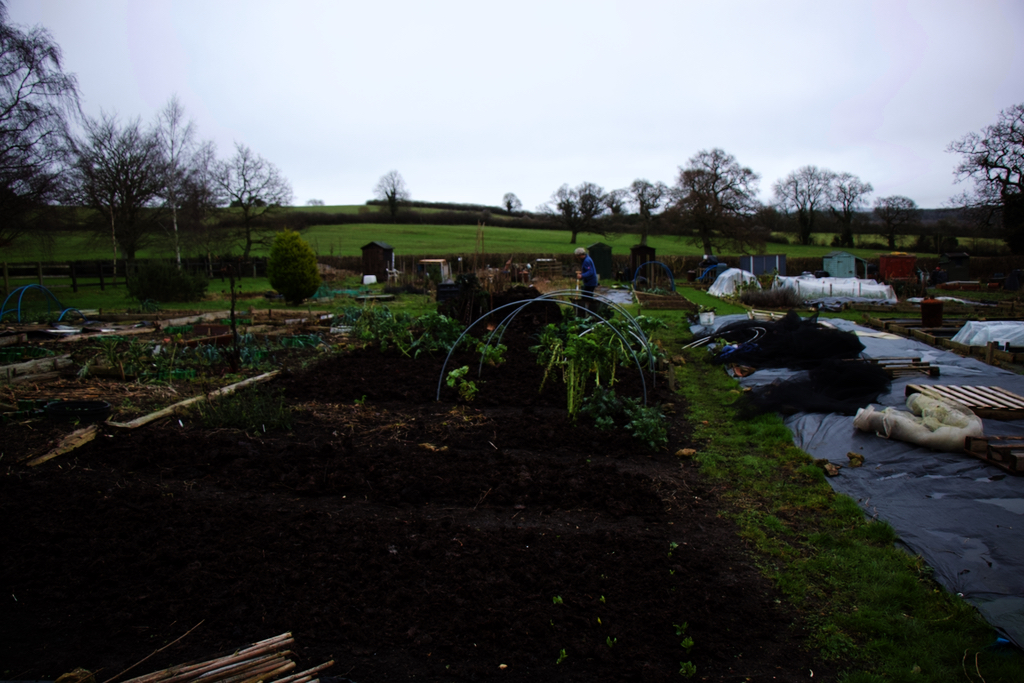
My allotment, mulched with compost in the winter
 Gardeners use many different kinds of mulches worldwide. Here in our damp, temperate climate compost works well because it does not provide a habitat for slugs, snails and woodlice – all creatures that like to chomp on our veggies. In other climates compost is often topped with hay, straw, wood chips, grass clippings and such like, all cosy homes for these pests in the UK. so I only use them in areas such as under currant bushes, not annual veg beds.

composted cow manure from a local farm
The compost can be composted anything – garden waste, animal manures, wood chip – as long as it has lived at some stage it can be composted, even old jeans. Spread on the beds, it is a rich environment, supporting a wide range of wildlife including toads, black beetles, dung beetles and birds, as well as flora and fauna which can not be seen by the human eye. It is most definitely not “bare earth”!
The compost mulch helps to conserve moisture, meaning less watering and better plant growth. Not disturbing the soil by digging improves the soil structure, which means that it is less likely to become waterlogged in wet weather or rock hard in the summer. I grow on heavy clay, but this method works for all soil types including sandy soils.

hoeing weeds at Homeacres
No dig gardening also helps to reduce weeds, because you are not bringing up annual weed seeds by digging the soil. Of course weed seeds blow onto the beds, or creep in from the edges, but with a compost mulch these are easy to hoe and keep under control. Having weed free beds makes life so much easier. There are fewer places for slugs and other pests to hide, and it makes intercropping (growing other edibles in the spaces between plants) and replanting so much easier. You can harvest a bed of garlic, for example, and straight away plant out beans or squash or brassicas – it saves time, too.
This means more crops in a smaller space. It enables me to grow a (relatively!) huge amount of food which keeps my family supplied year round (I am enthusiastic about preserving the harvest, so I can, dehydrate, freeze and preserve my harvests in many different ways). It’s surprising how much can be grown in just one no dig bed. At the no dig market garden I helped to set up, Homeacres (owned by Charles), he produces food year round for family and friends, courses and sells around £25,000 (around $31,700) worth of veg locally a year.

Charles ‘ no dig market garden, Homeacres in 2020

Fungi is a sign of healthy soil
Another benefit of not turning over the soil is that it ensures that the natural structure remains intact, open, alive and free draining. Mycorrhizae and other fungi thrive in undug soil; their role in soil health was not fully understood until relatively recently and we are learning more about the importance of fungi every year. They form a network in the soil which enables plants to feed better, access water and, according to research, is a form of communication – rather like a subterranean world wide web, connecting trees to plants to microscopic life. I wonder what they talk about…. what do you think?!
Sometimes people suggest that no dig gardening uses much more compost than digging methods. Certainly in the first year you can use a lot of compost (see my blog here about setting up a no dig garden – it’s about veganic methods but it’s the same with manure based composts too) depending on the kind of ground you are starting with, but for subsequent years it is the same as you’d use for digging methods, it’s just that with the compost on the surface it is more visible. After all, digging doesn’t make a soil fertile. All of the diggers at my allotment site dig compost in – either made themselves or bought from a local farmer. Because carbon retention is better for no dig soil rather than dug, you actually need less compost for the beds than you’d need for the same results if you’re digging. Not digging also helps to lock in carbon, because digging causes some oxidisation of carbon as CO2 – so it is better for the environment in this way, too.

No dig gardens enable more people to grow their own abundant crops. They are a boon for people who can only attend to their gardens for a few hours a week because they are easy to maintain. They enable people with different abilities and mobilities to grow their own, especially those for whom digging would be impossible or impractical. And they look beautiful.
I keep my beds as weed free as possible, but wildlife gardening and biodiversity is a key part of my gardening. I create wild edges with a wide range of habitats, flowers and other plants. This encourages bees, hoverflies, moths, bats, birds, wasps and other creatures to live in my garden. Many are beneficial predators of pests. I do not use any pesticides, instead the wild life – in particular predatory wasps – help to keep the populations of aphids and other bugs under control. It makes my garden and interesting and companionable place to be too – there’s always something to observe. I also use some crop protections, carefully secured down, including butterfly netting and enviromesh over some of my vegetables, especially the brassicas which are stripped by birds unless protected.


I love how no dig gardening helps me to grow delicious food in harmony with nature. When I started growing no dig it was still considered a bit of a strange way to grow, but now it is being enjoyed by gardeners everywhere, including gardens owned by the Royal Horticultural Society and the National Trust.

Some different ways to start no dig:
On very weedy ground, pread brown cardboard (tape and staples removed) or thick layers of damp newspaper (to stop it from flying off) over the weeds and cover with 2-6” (5 – 15 cm)of compost, as much as you have. Tamp down with the back of a rake or walk gently over the top and you can plant right away.
Another method for weedy ground is to spread less rotted compost and nutritious leaves (comfrey, nettle etc) over the grass and cover with a large sheet of pre-used polythene (ask around, there’s usually some to be had, I have a sheet that is 15 years old). If you do this in summer/autumn and leave until the following spring it should have rotted down into compost whilst killing the weeds. Another option is to do this in late spring, plant good sized squashes through holes into the soil beneath (if they are big they are less likely to be harmed by slugs) for a crop whilst sheet mulching. This method does create a habitat for slugs etc so it is worthwhile removing the polythene a few weeks before you want to plant to encourage the slugs to slither off.
If the beds are already mostly weed free, hoe off or trowel out any weeds and spread 1-2” (2-5cm) compost on the surface.
I prefer to have earth paths with a little compost on top. They are easy to hoe and the plants in the neighbouring beds can root into them, too. A very light sprinkling of partially rotted wood chip (think a few millimetres rather than centimetres) is good too. A deeper wood chip mulch can create a home for woodlice which, contrary to popular belief, do like to nibble on fresh plant matter as well as decaying wood.
This works even for plots which are full of bindweed, couch etc. During the first year you will need to be especially vigilant and remove any perennial weeds that pop through the mulch with a trowel or Hori Hori. After the first year or so, they have usually died off.










A good summation of no-dig. I can’t understand why my plot neighbours don’t see it – the usual complaint is it uses too much compost/manure, then you can’t hear yourself in spring for the rotavators digging in the manure! Your town looks great. I like to think that we don’t own the ground we cultivate – we just look after it for future generations, the way past generations have looked after it for us.
Thank you Alan. That’s a really good way to think about the soil we are growing on
Lovely written Stephanie. I actually don’t know another way of growing than no dig. When I started growing about 3 years ago I bumped into Charles’ website and that’s how I’ve been growing. So I really don’t know how is it that dig people grow…and have no desire to learn 🤣. I’m interested in your heavy clay soil. Haven’t you been able to improve it after all these years? I have 3 1.5 x 2.8 metres beds and lots of other smaller spaces around my garden. One of the beds is filled with just compost. The other 2 were supposed to also be filled with compost but I was missile clay type soil. As cross as I am, am now stuck with it. I have room to add a good 5-8cm of good compost next year but will the clay ever break down ? PS I started following you when I met you at one of Charles’ courses and ate your amazing food and realised you’re such a legend in your own right! Your Instagram content is amazing! Thanks for everything you share x
What lovely comments, thank you Bea. Yes, my clay soil is hugely improved with no dig methods, it has worked wonders 🙂
We have been trying or doing no dig on allotment for about 3 years now previous to that we took on the allotment and rotavated it and couch grass spread all over we had a very wet flooded season and it was under water at one half as it’s on a slope. It was like marshes. I lost all my fruit bushes. It’s heavy clay ground .when it dried out it was grass and rock hard we nearly gave up but started to cover with black polythene and you should have seen how many white roots of the grass we dug up. I then read an article about no dig and we have been trying to get it round now for 3 seasons. Some crops fail but we are learning. One year we had amazing parsnips and I know to sow earlyish but I had only 3 parsnips last year and none have germinated this year and so it was too late to sow anymore. The 3 parsnips grew massive as this kind as a marrow and about a metre long. Anyway I keep learning more and have just bought one of your books so we hoping to keep doing better till we are self sufficient all year round for fruit veg and salad crops. Thankyou
Hi Mandy, that’s the thing with gardening, one never quite knows how things will turn out! Sounds like you’re really good at persevering, happy growing!
I really enjoyed reading your blog this evening, I recently bought yours and Charles Dowding’s most recent publication “No dig organic home and garden” it really is transforming how I grow food and flowers for my family. A great, practical publication, which is being highly used, thankyou !
Thank you Sally, so glad you are enjoying the book
Just finished reading No Dig Home & Garden, truly inspirational. I have already made and planted 2 no dig beds on my allotment. More compost has been ordered and I hope to finish one half of the allotment in the next few weeks.
Half of my allotment has been covered for over 2 years and there are hardly any perennial weeds under the covers. I’m just going to make beds straight on the soil.
On the question of paths, should I lay cardboard or just a covering of aged tree chippings. We have a regular supply of this.
Regards Nig
Thank you Nigel.
If the paths are clear then there is no need for cardboard. I light layer of chippings is fine, if they are too deep then they can create habitat for slugs and woodlice. I usually just have compost paths, easy to hoe.
Thanks Stephanie, They are clear of weeds, so will go with the light spreading of wood chippings.
Your comment about reducing our personal carbon footprint by using the no dig method is so spot on, and needs to be emphased by all of us who practice it. Keeping carbon in the soil was one such reductuion of our carbonfootprint mentioned in the Carbon Literacy course I’ve just finished.
That’s interesting, so good it is being taught on these courses 🙂
I really enjoyed this post. It cleared up a question I had about compost vs. mulch on the garden beds. I have been converting my garden, and mulching (which potatoes really love a leaf mulch – you can harvest them right at soil level). But the danger is attacking pests.
So how does this differ from Square Foot gardening method in the US.
Thank you, Rob. I haven’t read the Square Foot gardening for years, but from what I recall a main difference is no dig is simpler with just the annual mulch (SF requires a lot of amendments) and SF is more prescriptive about what one plants in each square. No Dig doesn’t have the square grid method of planting.
Some people like to combine the two – composted mulches and the square grid method of planting.
I am just starting my first no-dig garden. I have spread down the cardboard over the plot where we have always grown our tomatoes. I will be putting 5 to 6 inches of compost on top of the cardboard. I will likely put in tomato plants in 3 weeks. Question: do the roots of the tomato plants manage to grow through the cardboard? Or should I make a hole in the cardboard where I transplant the tomato plant? Thank-you
It depends on the weather – if it is damp weather then there should be no problems for the roots to get through the card. If it is very dry, that could be more difficult