
Every year I look forward to Valentine’s Day – not for romantic reasons but for leafy ones! Because this is an excellent time to start your sowings for the year.
Here in Somerset the sun rose today at around 7:25 and will set at around 17:25, ten hours of daylight which is increasing every day from now on until the summer solstice. Or more accurately, it got light around then, because today is wild and wet, with grey skies – not much likelihood of seeing any sun!
 Sowing times depend very much on where you are, so if you live further north then you’ll likely need to start in a week or so. Adapt this according to your location and situation.
Earlier in the year, the days are too short for healthy growth for most seedlings, which are likely to become leggy as they struggle for light. Of course we still have a long way to go before the last frost date, which is mid-May in Bruton, Somerset so almost everything that I sow in February is frost hardy.
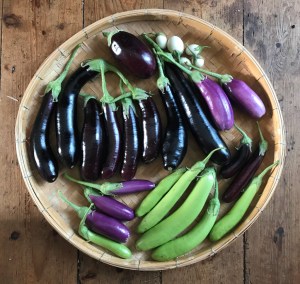 Some exceptions are aubergines, chillies and sweet peppers. These warmth loving plants take a long time to grow in our climate, so I usually start them in late January/early February – but I do have heat mats, grow lights and plenty of undercover space where I can keep the seedlings and young plants frost free until May. They will germinate and grow perfectly well on a windowsill, but consider how much space you’ll have to cherish your little plants indoors and sow accordingly. One year before I had heated propagators etc, I was far too enthusiastic with my sowing and tried to keep each baby alive, resulting in windowsills crammed with leggy plants!
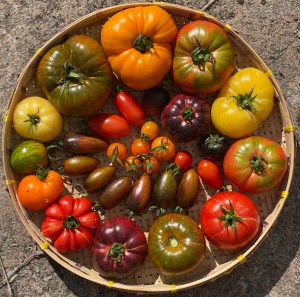 It is too early to sow tomatoes!
I sow tomatoes in March. They grow quickly and are not frost hardy. Sowing too early increases the likelihood of leggy plants which are more susceptible to aphids and other problems. If you really can’t wait, sow 2-3 seeds and cherish one early tomato plant on your windowsill – but save the rest for later on!
Many seed packets encourage earlier sowings, but just ignore those! There are also lots of social media posts encouraging a sowing-fest, but growing really isn’t a race and quite often the “advice” is more about increasing followers than offering tried and tested tips from experience. I’ve been growing veg since I was 17 (marrows, to make wine!) thirty-seven years ago (oh my!), houseplants since I was a little girl.
What To Sow In February
Almost all of my February sowings are undercover – sown into seed trays/modules in a greenhouse, polytunnel, windowsill, cold frame or other space that is protected from the worst of the weather. The few that I sow outside are:
Outside: assuming the ground isn’t frozen or covered with snow!
broad beans including red flowered broad beans such as “Crimson Flowered” and “Epicure”, which are worth growing for the cheery blossoms and deep red beans.
carrots, early varieties, with protection (inside a polytunnel, or under a cloche)
early peas including Oskar and Havel (although I mostly start these off indoors to protect against mice)
garlic, especially spring planted varieties – it will say that on the packet. If the ground is frozen, these can be started in small pots and planted out later on
Under cover:
artichoke
broad beans
early brassicas (cauliflower, turnip, kohl rabi, calabrese, cabbage, Cima di Rapa)
chives
coriander
dill
Florence fennel (only the slow bolting varieties, check the packet)
lettuce
microleaves – whatever you fancy
onions – both spring (scallions) and bulbing onions
parsley
pak choi – choose a slow bolting variety and harvest young
peas – early podding varieties and for pea shoots
radish
sweet peas – not to eat, for the flowers
On Warmth:
aubergines
chillies
sweet peppers
Some sowing tips
I start almost everything in seed trays or modules, planting out as sturdy transplants. This means that I only plant out the healthiest plants, and they are less likely to be nibbled by slugs. Also, starting sowing off indoors, especially at a time of year when weather conditions are poor, increases germination and means that the harvests are often weeks earlier than if I sowed outside.
The key exceptions are parsnips and carrots which I always direct sow.
Using this method, I can start 20 or more different varieties in one tray, saving space and compost.


Once the greenhouse starts filling up with modules, keep a look out for slugs, who may think that the underneath of the trays are cosy quarters. This one was caught in action!
 Propagating lids are helpful to maintain a comfortable environment for seedlings, especially if your greenhouse (or growing space) is draughty with holes, like mine. You can upcycle clear plastic containers to make your own.
Charles doesn’t need to use these in his greenhouse for example, because it is well made.


I sow some seeds, such as beans, peas and multisown radish and onions, directly into modules.

Eventually, the greenhouse looks like this – this is May! I’ve had most of these module trays for years so although there is a lot of plastic here, much it was second hand and it makes environmental sense to use up what I have and replace with more ecological alternatives in the future, as required.

The greenhouse in May
Happy sowing!
 Regular readers will know that I am not doing any sowing myself just now, because I am moving house in a few weeks, near to Lampeter in Wales. So this is what I have done in previous Februarys for the twenty years I have lived here in Bruton, and in the various places where I have worked as a grower.
All of my seeds are in this storage box waiting to be packed. I’ve got a lot of seeds (it’s my work), including many home saved ones from my garden here. The module trays are some new ones designed by Charles, which I’ve not tried out yet. They should last at least a decade.
I’ve also got some home saved Jerusalem artichokes and Chinese artichokes, plus some spring sowing garlic (kindly sent to me by Mr Fothergills) to pack in here. And seed potatoes which are in trays chitting behind my desk.











Best of luck with your move, hope you enjoy your new home. I look forward to hearing how you get on. Best wishes Frances
Thank you Frances. We hope to be able to set moving dates this week.
I am so looking forward to seeing your new space in Wales!
Me too! I last saw it at the end of November!
Wonderful advice – thank you again!
Thank you Clare
GOOD INFORMATION AND PRESENTATION
Thank you
Morning come across your article by accident , still abed in the Hebrides. So straight forward and informative , my incentive for the day , in a mares poly cub. Good luck with your move. Thank you. Andrea.
Thank you so much, Andrea
Very useful information. Thank you
Thanks, Raymond
To the point as usual. so helpful. in the May greenhouse photo, it looks like you started sweetcorn in cell trays. is that right, and if so, did it work? I’ve always read that you cant transplant sweetcorn. Thanks Julie. PS. good luck with your upcoming move.
Yes, I always start sweetcorn off in modules – in April, not now. Works really well.
Thank you – it’s at the very stressful part of things!
Thank you for the inspiration. It’s always good to get a nudge to “get growing”. All the best with your move and settling in.
Thank you Chris
Thanks for all your tips. Will definitely sow multiple varieties in each tray. Never done that before and always run out of room in the greenhouse and have too many seedlings of each – so it’s such a good idea!
Thank you Chantal – happy growing
Fantastic. We moved to lampeter 2 years ago, old farmhouse empty for over a year. In the poly tunnel were last years grapes, cleaned and trimmed they produced a mega crop which we converted into chateau parc y rhos. We lived in a caravan for 18 months while gutting and refurbishing the house, so now this year it is time to get planting, and we very much favour no dig policy. All our growing area is in raised beds, as the top soil has been removed by flooding in the past. We obtained soil for the beds from mole hills in the field. So far have planted onion seeds and garlic, and am keeping a close eye on the calendar for what is next.
Do hope your move goes well, our only regret is not doing it sooner.
Thank you Sharon. Your project there sounds fantastic and we’ll almost be neighbours!
Stephanie, I was just wondering if you have checked that your new house is ok in Wales, as we have had biblical wind and rain here for a few days and many places are flooded. We have had to postpone our turf cutting for our new poly tunnel frame. Hopefully it will be drier towards the weekend. Regards,
Thanks Sharon. I am sure the current owners would tell me if anything has happened to the house.
What I am looking for are sweet potato slips any body got any ideas.
Best ofl luck your move.
Thanks John.
I had some slips from Mr Fothergills last year which were a great success for the UK.
Hi Stephanie, I hope you have found lots of good growing space in Lampeter, I’ve always wanted to move there and have a smallholding or just more land to grow stuff on. We sometimes go to Lampeter from Cardiff for a day out. So good on you taking the plunge and just doing it, its such a big brave thing to do. I do admire you. I hope you will be happy and feel energised to make a lovely home and garden. lots and lots of love Jackie xxxx
Thank you Jackie, what a kind and thoughtful message. The garden is around 0.4 acre, so bigger than I have now but not too big to manage on my own.
I’m moving with my adult student sons, but they have to focus on their degrees more than gardening!
*suspected that you had moved as it had gone very quiet. Welcome to Wales. This is the best time to start on a new garden project, planning and constructing, so much to do. My poy tunnel , which is 10m x 3.6m is progressing well, the inside is complete with beds, staging and an ibc tank full of water. We have not put the polythene on yet as we are waiting for a calm, warm day. By the way, do get some chickens, I have found that they make a home complete and are dear little souls. Happy gardening.l
Sounds good, Sharon!
Yes, we moved here yesterday afternoon, so still in the middle of unpacking. Starting the new garden at the weekend, seed sowing first and then mulching. The polytunnel is ordered for August.
I’m not having any animals, at least not for some time.